LEL and UEL Help Prevent Fires and Explosions
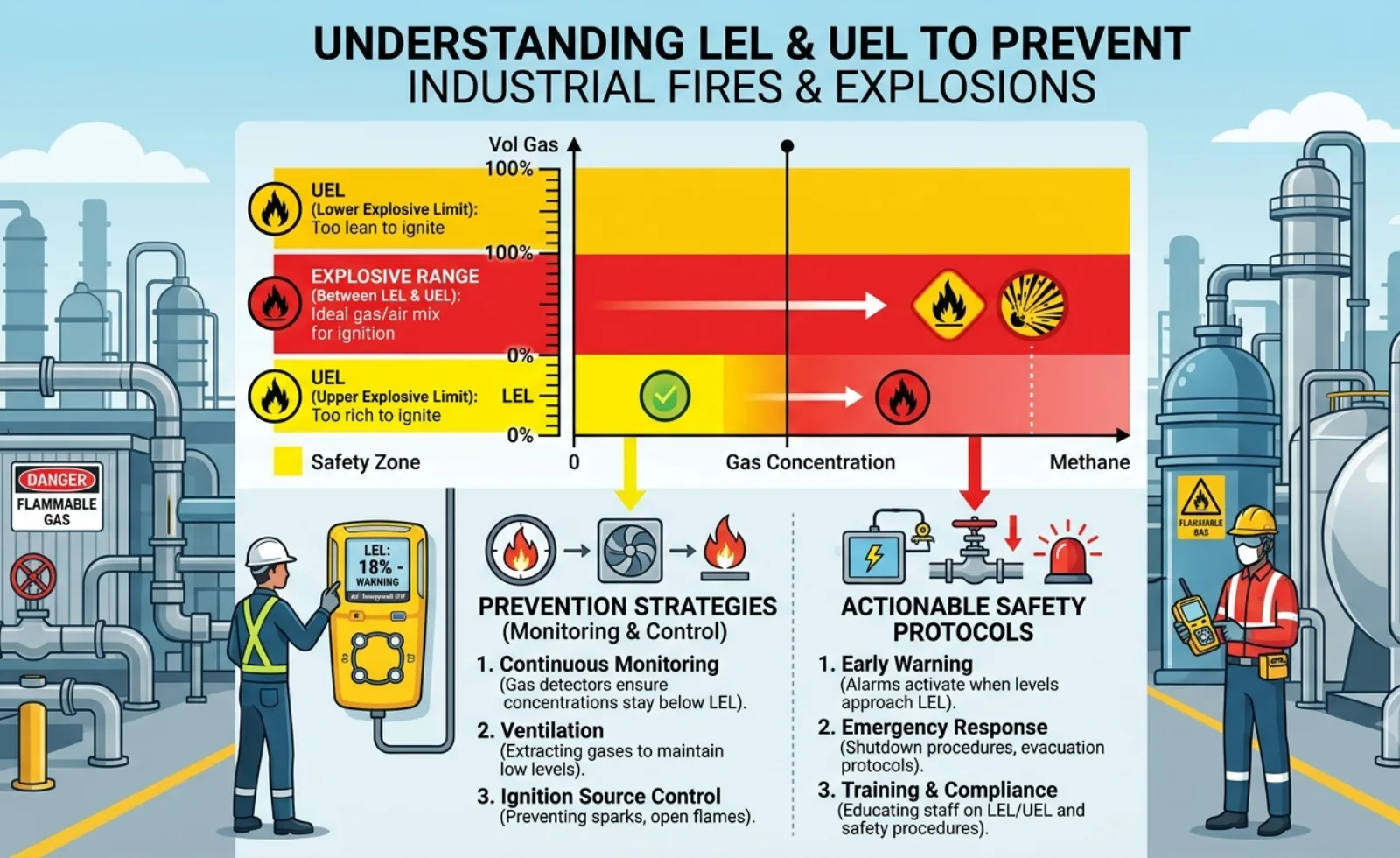
How LEL and UEL Help Prevent Fires and Explosions in Industrial Workplaces Walk into almost any facility that handles flammable gases, whether it is a refinery, a chemical plant, a paint shop, or a confined storage tank, and you will find gas monitors clipped to workers’ belts or mounted on the walls. Most people glance at the reading and move on. Few stop to think about what those numbers actually mean, or why they can be the difference between a normal shift and a catastrophic explosion. Two terms sit at the heart of this protection: LEL and UEL, short for Lower Explosive Limit and Upper Explosive Limit. Understanding them is not just technical trivia for gas detection engineers. It is core knowledge for anyone responsible for safety in an industrial environment. This article explains what LEL and UEL actually mean, why the space between them is so dangerous, and how this knowledge translates into real prevention strategies on the ground. What Are LEL and UEL, in Plain Terms? Every flammable gas or vapour has a specific range of concentrations, mixed with air, within which it can catch fire or explode. This range is called the flammable range, and it sits between two boundary points. The Lower Explosive Limit (LEL) is the lowest concentration of gas in air that can ignite if it meets a spark, flame, or other ignition source. Below this point, there simply is not enough fuel in the mixture to sustain combustion, no matter how strong the ignition source is. The gas is considered too “lean.” The Upper Explosive Limit (UEL) is the opposite boundary. It is the highest concentration of gas in air that can still ignite. Above this point, there is too much gas and not enough oxygen to support a flame. The mixture is considered too “rich.” Between these two limits lies the danger zone. Any concentration that falls inside this window, between the LEL and the UEL, can ignite if it meets a spark, hot surface, static discharge, or open flame. Outside this window, on either side, the gas will not ignite under normal conditions. Take methane as a simple example. Its LEL is roughly 5% by volume in air, and its UEL sits closer to 15%. This means a room where methane makes up less than 5% of the air is relatively safe from ignition, and a room where it exceeds 15% is also outside the ignition range. But anywhere between those two numbers, a single spark could trigger a serious explosion. Why This Range Is So Dangerous The tricky part about the flammable range is that gas concentrations rarely stay still. A slow leak, a ventilation failure, or a change in temperature can push gas levels up through the LEL and toward the UEL, or pull them back down again. A space that reads safe one moment can become dangerous minutes later, and vice versa. This is exactly why experienced safety professionals treat a “0% LEL” reading with caution rather than blind trust, especially inside tanks, vessels, or enclosed spaces that previously held flammable substances. In rare but serious cases, a gas concentration can rise so high that it moves entirely above the UEL, which can cause certain sensors to read artificially low or even zero. The danger has not disappeared; the mixture has simply become too rich to ignite at that exact moment. The moment fresh air is introduced, through ventilation or an opened hatch, the concentration can drop back down through the UEL and into the explosive range, creating a serious risk exactly when workers assume it is safe to proceed. This is one of the most important reasons gas detection is treated as a continuous process, not a one-time check before entering a space. How LEL and UEL Monitoring Prevents Real Incidents Fires and explosions need three things to occur together: fuel, oxygen, and an ignition source. Take away any one of these three, and combustion cannot happen. LEL and UEL monitoring directly targets the fuel side of that equation, making sure gas concentrations never sit inside the explosive range where ignition becomes possible. In practice, this plays out through a few key strategies: Continuous gas detection. Fixed and portable gas detectors are placed in areas where flammable gases could accumulate, such as near storage tanks, pipelines, compressors, and confined spaces. These devices constantly sample the air and display readings as a percentage of the LEL, rather than a raw gas concentration, making the danger level easy to interpret at a glance. Early warning alarms. Detectors are typically configured to trigger a first alarm at a low percentage of the LEL, often around 10%, giving workers time to respond before conditions become critical. A second, higher alarm, commonly set around 20% of the LEL, usually signals that evacuation is needed immediately. This tiered approach gives teams a real buffer zone between “something is wrong” and “we are in the explosive range.” Ventilation control. When gas levels rise, increasing ventilation is one of the fastest ways to dilute the concentration and push it back below the LEL, keeping the atmosphere outside the flammable range. Ignition source control. Hazardous area classification systems, which rate zones based on how likely flammable gas is to be present, guide decisions about which electrical equipment, tools, and hot work practices are allowed in a given space. This reduces the chance of a spark or hot surface meeting gas that has drifted into the explosive range. Leak identification. A rising LEL reading is often the first sign of an equipment fault, a corroded pipe, or a failed seal. Monitoring data helps maintenance teams locate and fix the source before it becomes a bigger hazard. Together, these measures do not just detect danger. They actively keep gas concentrations away from the explosive range in the first place, which is a far safer approach than relying on ignition control alone. Where LEL and UEL Monitoring Matters Most Some industries face a much higher exposure to flammable … Read more