How to Register as an ADOSH Senior Practitioner: Requirements, Process, and the Role of the NEBOSH International Diploma
If you work in occupational safety and health (OSH) in Abu Dhabi, you have probably heard the term “OSH Senior Practitioner” mentioned in job ads, tender documents, or compliance conversations. This title is not just a job label. It is an official registration issued by the Abu Dhabi Public Health Centre (ADPHC) under the Abu Dhabi Occupational Safety and Health System Framework, commonly known as ADOSH-SF.
For safety professionals who want to move into senior, consultancy, or high-risk-entity roles, this registration is often a hard requirement, not a nice-to-have. In this guide, we break down what the registration means, who needs it, what qualifications you need (including where the NEBOSH International Diploma fits in), and how to actually apply.
What Is ADOSH-SF and Why Does It Matter?
ADOSH-SF is the regulatory framework that governs occupational safety and health across the Emirate of Abu Dhabi. It replaced the older OSHAD system, and it is now managed by ADPHC. The framework exists to make sure that workplaces, whether construction sites, factories, hospitals, or offices, are managed by people who actually understand risk, hazard control, and legal compliance.
Within this framework, Mechanism 7 covers how OSH practitioners and OSH service providers get registered. It is split into different levels, and the one this article focuses on is Mechanism 7.2, which governs OSH Senior Practitioners.
Who Needs to Register as an OSH Senior Practitioner?
Under Mechanism 7.2, this category is meant for two kinds of professionals:
- Someone employed by an OSH consultancy office that delivers safety services to private or government organisations inside Abu Dhabi.
- Someone employed directly by a private or public sector organisation, acting as the senior person responsible for OSH in a business classified as high-risk under ADOSH-SF.
In simple terms, if you are the lead safety expert advising clients, or the top safety authority inside a high-risk company, this registration applies to you. It sits one level above the OSH General Practitioner category (Mechanism 7.1), which is meant for in-house safety officers, coordinators, and supervisors working at an operational level rather than a senior or advisory one.
Why Bother Registering?
Some professionals wonder if this is just paperwork. It is not. Here is what the registration actually does for your career:
- It confirms, on an official public register maintained by ADPHC, that you have met a defined competency benchmark.
- It is often a legal precondition for OSH consultancy offices to operate in Abu Dhabi. A consultancy cannot maintain its own licence without at least one registered Senior Practitioner on staff.
- It signals to employers and clients that your safety judgement has been independently checked, not just self-declared on a CV.
- It opens doors to leadership roles in high-risk sectors such as construction, oil and gas, healthcare, and manufacturing.
Eligibility Requirements for OSH Senior Practitioner Registration
The core requirement under Mechanism 7.2 is qualification-based. To be eligible, an applicant must hold either:
- A qualification in occupational safety and health that is equivalent to National Qualification Framework (NQF) Level 7, or
- A recognised professional membership or credential from an accepted international safety body, supported by an official certificate or membership letter.
NQF Level 7 broadly sits at postgraduate or advanced professional level, well above the entry-level certificates that qualify someone for the General Practitioner category. This is where the choice of qualification becomes important, because not every safety course on the market is pitched at this level.
Where the NEBOSH International Diploma Fits In
This is the part many applicants get wrong, so it is worth spending time on.
The NEBOSH International Diploma in Occupational Health and Safety is widely regarded as one of the most advanced, globally respected qualifications a safety practitioner can hold. It is pitched at degree-equivalent level, sitting at Level 6 on the UK’s National Qualification Framework and Level 10 on the Scottish Credit and Qualifications Framework, which is broadly comparable to an honours degree standard.
Because of its depth and academic weight, the NEBOSH International Diploma is one of the qualifications most frequently accepted as evidence of NQF Level 7-equivalent competency when applicants apply for OSH Senior Practitioner registration in Abu Dhabi. Rather than testing narrow, task-based knowledge, the Diploma covers strategic risk management, health and safety law, workplace hazard control, and management systems in real depth, which lines up closely with what a senior practitioner is expected to know and apply on the job.
This is also why so many candidates preparing for ADOSH registration choose the NEBOSH International Diploma as their study path. It does more than tick a box on an application form; it builds the analytical and managerial skill set that a senior OSH role genuinely demands, from auditing management systems to advising boards on risk exposure.
It is worth noting that qualification equivalency can be assessed against frameworks such as the ones published by national qualifications authorities, and specific equivalency should always be confirmed directly with ADPHC or through the National Qualifications Authority guidance available at the time of application, since requirements can be updated.
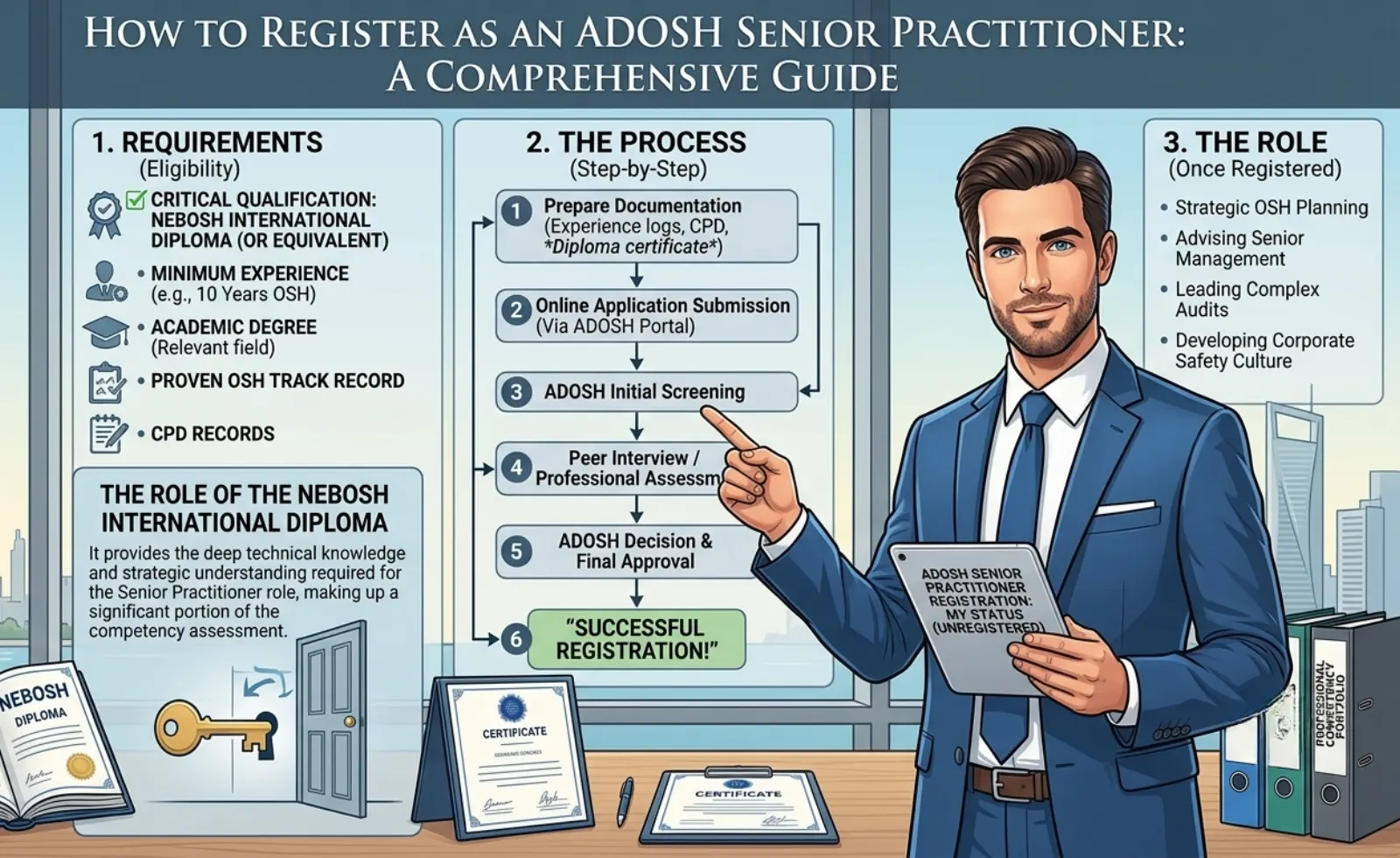
Step-by-Step: How to Apply for OSH Senior Practitioner Registration
All applications go through the Abu Dhabi Government Services Platform, known as TAMM. Here is how the process generally unfolds:
Step 1: Create or update your TAMM profile. Make sure your personal details are current before you start the application itself.
Step 2: Complete the application form. You will be asked to select the OSH Senior Practitioner category and confirm which pathway you are applying under (qualification-based or professional membership-based).
Step 3: Upload supporting documents. This includes your qualification certificate (such as your NEBOSH International Diploma certificate) or your professional membership evidence, plus any identification documents requested.
Step 4: Fill in your online CV. ADPHC requires a detailed record of your work experience directly on the platform. Accuracy matters here, since this information can be checked during audits or reviews later.
Step 5: Sign the Code of Conduct and Conflict of Interest Declaration. This is a digital signature confirming you will act ethically and disclose any conflicts of interest in your OSH work.
Step 6: Pay the registration fee. The fee is set by ADPHC and should be confirmed on the TAMM platform at the time of application, as fees can be revised.
Step 7: Wait for ADPHC’s decision. You will receive one of three outcomes: approval, rejection, or a request for further information. If additional documents are needed, respond promptly to avoid delays.
Step 8: Receive your digital registration card. Once approved, your registration card is issued through TAMM, where you can view and print it whenever needed.
Linking Your Registration to a Consultancy Office
If you work for, or plan to join, an OSH consultancy office, there is an extra layer to understand. Once your individual registration is approved, the consultancy office can add you to their staff list to satisfy their own registration requirements with ADPHC. You will get a notification when this happens, and you have the right to approve or reject the link. Importantly, you can only be linked to one consultancy office at a time. If you switch employers, the new registration automatically removes the old one, so keeping your employment details current is your responsibility, not just a formality.
Keeping Your Registration Active
Registration is not a one-time event. OSH Senior Practitioners are generally expected to maintain their status through Continual Professional Development (CPD), with records that can be audited. Each CPD activity you log should be genuinely relevant to your OSH skill set and properly evidenced, since ADPHC can request proof at any time. Treat your CPD log the same way you would treat a compliance document: accurate, current, and defensible.
Common Mistakes to Avoid
- Assuming any safety certificate qualifies. Entry-level certificates rarely meet the Level 7-equivalent bar required for Senior Practitioner status.
- Submitting an incomplete online CV. Vague job descriptions without dates, responsibilities, or evidence slow down approval.
- Ignoring renewal timelines. Missing a renewal window can mean starting the application from scratch.
- Ambiguous employment status. Not updating your consultancy office link when you change jobs can create compliance issues for both you and your employer.
Frequently Asked Questions
What is the difference between an OSH General Practitioner and an OSH Senior Practitioner?
An OSH General Practitioner is typically an in-house safety officer or coordinator working at an operational level, registered under Mechanism 7.1 with an NQF Level 4-equivalent qualification. An OSH Senior Practitioner, registered under Mechanism 7.2, is a more senior role, either working for a consultancy office or acting as the lead safety authority in a high-risk organisation, and requires a higher-level qualification equivalent to NQF Level 7.
Does the NEBOSH International Diploma automatically qualify me for OSH Senior Practitioner registration?
The NEBOSH International Diploma is widely accepted as meeting the qualification standard expected for this category because of its advanced, degree-equivalent level. However, final equivalency decisions rest with ADPHC, so it is wise to confirm your specific case before applying.
How long does the ADPHC registration process take?
Timelines vary depending on how complete your application and documents are. Applications with accurate, well-evidenced CVs and correctly uploaded certificates tend to move through review faster than incomplete submissions.
Can I hold OSH Senior Practitioner registration with more than one employer at once?
No. You can only be linked to one consultancy office at any given time. Registering with a new employer automatically removes the link to your previous one.
What happens if my application is rejected?
ADPHC will explain why your application did not meet the minimum requirements. You can address the gaps, whether in qualifications, documentation, or experience evidence, and reapply.
Is CPD mandatory for OSH Senior Practitioners?
Yes. Unlike the General Practitioner category, Senior Practitioners are generally required to maintain and evidence ongoing CPD activity to keep their registration valid, and these records can be audited
Where do I actually submit my application?
All applications for OSH Senior Practitioner registration are submitted through the Abu Dhabi Government Services Platform, TAMM, where you also manage your online CV, documents, and digital signatures.
Can professional memberships replace a formal qualification for this registration?
Yes, in many cases a recognised professional credential or membership from an accepted international safety body, supported by an official certificate, can be used as an alternative pathway to meeting the eligibility requirement.
Is registration a one-time process or does it need renewal?
It requires renewal. You are expected to keep your registration active through CPD evidence, updated employment information, and compliance with the Code of Conduct.
Who should consider taking the NEBOSH International Diploma?
Safety professionals aiming for senior, advisory, or consultancy-level roles, particularly those planning to register as an OSH Senior Practitioner in Abu Dhabi, generally benefit most, since the qualification is built around strategic risk management rather than entry-level task knowledge.
Final Thoughts
Becoming a registered OSH Senior Practitioner under ADOSH-SF is one of the clearest ways to prove your seniority and credibility as a safety professional in Abu Dhabi. The path is straightforward once you understand it: hold a qualification equivalent to NQF Level 7 or an accepted professional credential, apply through TAMM with accurate documentation, and keep your CPD and employment records up to date afterward.
For many practitioners, the NEBOSH International Diploma remains the most practical route to meeting the qualification bar, precisely because it builds real strategic safety competence, not just exam knowledge. Interestingly, the same attention to detail that safety consultancies apply to compliance work often carries over into how they present themselves online, and it is increasingly common to see OSH firms investing in
Whether you are just starting to research this pathway or you are ready to submit your application, taking the time to understand the requirements now will save you time, money, and frustration later.