
Workplace Safety Made Simple: Understanding Risk Ratings, Man-Hours, LEL, SWL and Essential Safety Calculations
Why Workplace Safety Feels Hard (And Why It Does Not Have To Be)
Most business owners do not ignore safety on purpose. They ignore it because it looks complicated. Terms like LEL, UEL, SWL, LTIFR and risk matrix sound like they belong in an engineering textbook, not in a busy workshop, warehouse or construction site.
But the cost of confusion is very real. One injury can stop a project, trigger an investigation, raise insurance costs, damage client trust and hurt a family. The good news is that the core of workplace safety rests on a handful of simple ideas and a few basic calculations. Once you understand them, you can make better decisions and ask better questions.
This beginner guide explains workplace safety made simple: what risk ratings mean, how to count man-hours, what LEL and SWL are, and which safety calculations every owner, supervisor and safety officer should know.
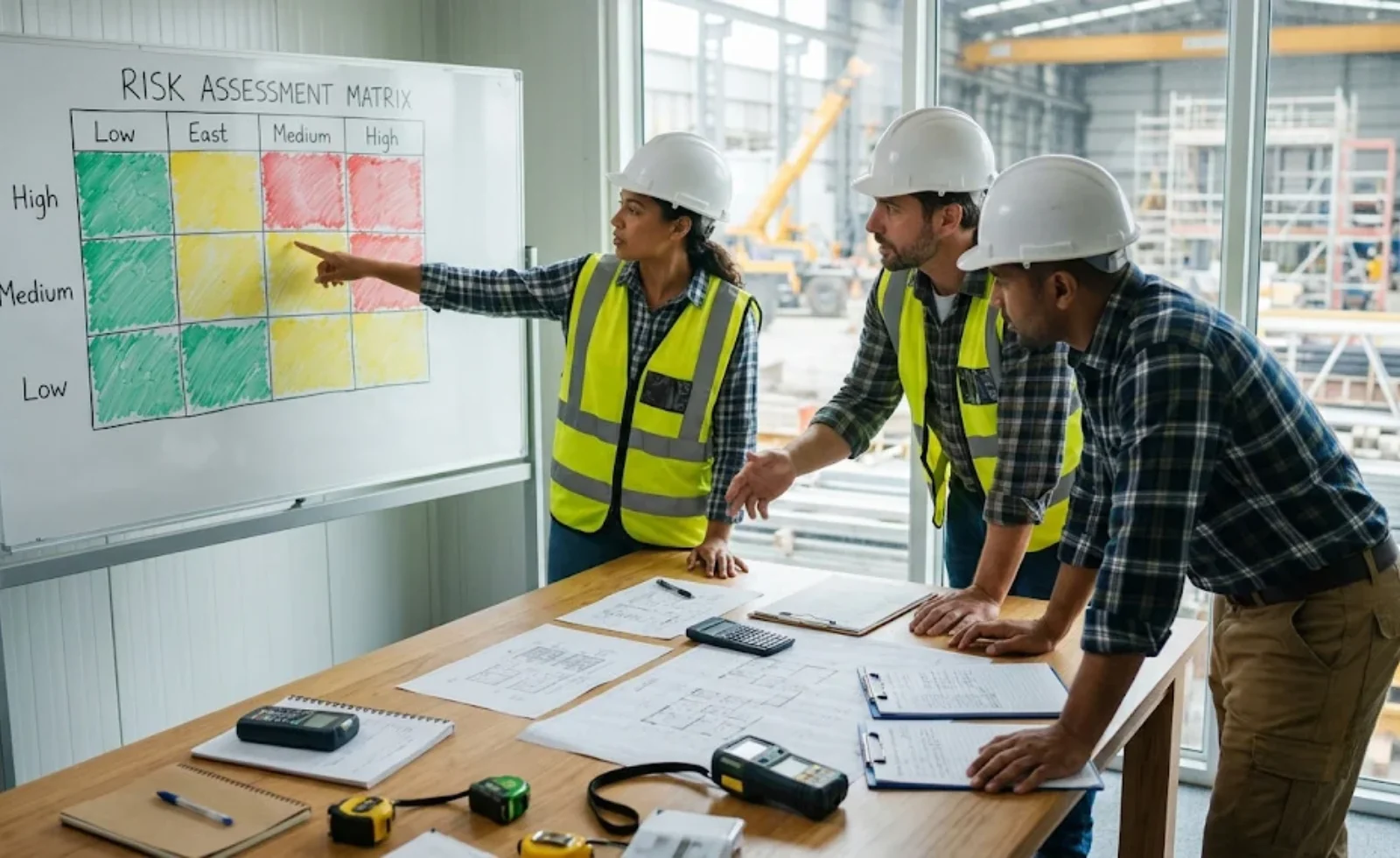
Quick Answer: What Are the Essential Safety Basics?
- Risk rating: a score that shows how serious a hazard is, calculated as likelihood multiplied by severity.
- Man-hours: the total hours worked by all employees in a period. It is the base number for measuring safety performance.
- LEL (Lower Explosive Limit): the lowest concentration of a flammable gas or vapour in air that can ignite.
- UEL (Upper Explosive Limit) is the highest concentration of a flammable gas or vapour in the air that can catch fire or explode when exposed to an ignition source.
- SWL (Safe Working Load): the maximum load a piece of lifting equipment should carry in normal use.
- Safety calculations: simple formulas, such as injury frequency rate, that turn incidents into numbers you can track and improve.
1. Risk Ratings: Turning Worry Into a Number
Every workplace has hazards. A hazard is anything that can cause harm, such as a wet floor, a spinning blade or a poorly stacked pallet. A risk is the chance that the hazard will actually hurt someone, combined with how bad that harm could be.
A risk rating gives you a simple way to compare hazards and decide what to fix first.
The basic formula:
Risk Rating = Likelihood × Severity
Most companies score each factor from 1 to 5.
Score | Likelihood (how often could it happen?) | Severity (how bad could it be?) |
1 | Very unlikely | Minor, first aid only |
2 | Unlikely | Medical treatment needed |
3 | Possible | Lost time injury |
4 | Likely | Major injury or long-term harm |
5 | Almost certain | Fatality or multiple serious injuries |
A worked example: A forklift shares a walkway with pedestrians. Likelihood of a collision is 3 (possible). Severity is 5 (a serious crush injury could be fatal). The risk rating is 3 × 5 = 15.
What the score means (bands vary by company, so check your own policy):
Rating | Level | What to do |
1–4 | Low | Monitor and keep existing controls |
5–9 | Medium | Improve controls within a set time |
10–16 | High | Act quickly, work should not continue without extra controls |
17–25 | Critical | Stop the work until the risk is reduced |
In our forklift example, a rating of 15 is high. The fix is not to buy more warning signs. It is to apply stronger controls, such as separate pedestrian walkways, barriers, a speed limit and trained operators.
Tip: Always rate the risk twice. Rate it once before controls (inherent risk) and again after controls (residual risk). If the second number is not clearly lower, your controls are not working.
2. Man-Hours: The Number Behind Every Safety Statistic
A man-hour (often called a person-hour or work-hour) is one hour of work done by one person. It sounds basic, yet it is the foundation of almost every safety rate you will ever calculate.
Formula:
Man-Hours = Number of Workers × Hours Worked per Person
Example: A site has 50 workers. Each works 8 hours a day for 26 days in a month.
50 × 8 × 26 = 10,400 man-hours
Why does this matter? Because ten injuries in a company with 20,000 man-hours is a very different story from ten injuries in a company with 2,000,000 man-hours. Without man-hours, you cannot fairly compare sites, months or contractors.
Common mistakes to avoid:
- Forgetting to include overtime, supervisors and contractors.
- Counting paid leave as hours worked.
- Using estimates instead of timesheet or attendance data.
3. Safety Performance Calculations Every Owner Should Know
Once you know your man-hours, you can measure how safe your workplace really is. Here are the most widely used formulas.
Lost Time Injury Frequency Rate (LTIFR)
LTIFR = (Number of Lost Time Injuries × 1,000,000) ÷ Total Man-Hours Worked
Example: 2 lost time injuries in 200,000 man-hours. (2 × 1,000,000) ÷ 200,000 = 10
That means 10 lost time injuries for every million hours worked.
Total Recordable Incident Rate (TRIR)
Common in OSHA-style reporting, TRIR uses a base of 200,000 hours, which equals 100 full-time employees working for a year.
TRIR = (Number of Recordable Incidents × 200,000) ÷ Total Man-Hours Worked
Example: 3 recordable incidents in 200,000 man-hours. (3 × 200,000) ÷ 200,000 = 3
Severity Rate
Severity Rate = (Total Days Lost × 1,000,000) ÷ Total Man-Hours Worked
This shows how serious your injuries are, not just how often they happen. A company with few injuries but long recovery periods needs to know that.
Safe Man-Hours
Many sites display a board saying “500,000 safe man-hours without a lost time injury.” It is simply the running total of man-hours since the last lost time injury. It is a useful motivator, as long as it never discourages workers from reporting incidents.
Important: Use one consistent base (1,000,000 or 200,000) across all reports. Mixing them makes your numbers meaningless.
4. LEL: The Invisible Hazard in Confined and Hot Work Areas
LEL stands for Lower Explosive Limit. It is the lowest concentration of a flammable gas or vapour in air that can catch fire or explode when it meets an ignition source. Below the LEL, the mixture is too lean to burn.
For example, methane has an LEL of roughly 5% by volume in air. At 5%, the air-gas mixture can ignite. Each gas has its own LEL, so always check the safety data sheet.
How LEL is used on site:
Gas detectors usually show readings as a percentage of LEL, not as a percentage of gas in air. So 100% LEL equals the point where the mixture can ignite, and 10% LEL means one-tenth of that level.
Example: If the methane LEL is 5% by volume, then 10% LEL is 0.5% methane in air.
Practical rules (always follow your site permit and local regulations):
- Test the atmosphere before entering a tank, pit, trench or confined space.
- Many permit systems set an alarm at 10% LEL and require work to stop or the area to be evacuated and ventilated if readings rise.
- Hot work such as welding or cutting should not start unless gas readings are safe.
- Check oxygen too. A safe breathing range is generally considered to be about 19.5% to 23.5%.
- Calibrate and bump test your gas detector as per the manufacturer’s instructions.
There is also a UEL (Upper Explosive Limit), the point above which the mixture is too rich to burn. The range between LEL and UEL is the dangerous zone. Never assume a space is safe just because the reading looks high or low. Always test properly.
5. SWL: Lifting Safely Without Guesswork
SWL stands for Safe Working Load. It is the maximum load a crane, hoist, sling, shackle or other lifting accessory is rated to lift under normal conditions. You will often see it stamped or tagged on the equipment. Many modern standards use the term WLL (Working Load Limit), which means the same thing in practice.
SWL is not the point where equipment breaks. It is a reduced figure that includes a built-in safety margin.
Safety Factor = Minimum Breaking Load ÷ SWL
Example: A sling with a breaking load of 5,000 kg and an SWL of 1,000 kg has a safety factor of 5:1.
Never forget the sling angle. When you lift with two or more slings, the tension on each leg increases as the angle between them gets wider.
Tension per leg (two-leg sling) = Load ÷ (2 × cos of the angle from vertical)
Example: You lift a 2,000 kg load with a two-leg sling. Each leg is 30° from vertical (a 60° angle between the legs).
Tension per leg = 2,000 ÷ (2 × 0.866) = about 1,155 kg
Each leg carries more than half the load. If the angle widens, the tension climbs fast, which is why sharp angles are a common cause of sling failure.
SWL checklist:
- Know the real weight of the load. Do not guess.
- Check the tag and make sure the equipment has valid inspection or test records.
- Reduce the working limit when angles, shock loads or sharp edges are involved.
- Use trained riggers, signallers and operators.
- Never stand under a suspended load.
6. How These Five Topics Work Together
Think of them as parts of one system:
- Risk ratings tell you what to fix first.
- Man-hours give you the base to measure results.
- LTIFR, TRIR and severity rate show whether things are improving.
- LEL and UEL checks protect people from fire, explosion and toxic atmospheres.
- SWL calculations keep lifting operations under control.
A business that uses all five can answer three powerful questions: What could go wrong? How are we doing? What should we do next?
7. Business Pain Points This Knowledge Solves
- “Our accident numbers look bad, but we do not know why.” Proper rates and trends show where incidents are concentrated.
- “Clients keep asking for safety statistics in tenders.” Accurate man-hours and LTIFR help you respond with confidence.
- “Insurance premiums keep rising.” A documented risk process and falling incident rates strengthen your case.
- “We rely on one safety person who knows everything.” Training supervisors in basic calculations spreads responsibility across the team.
- “Inspections feel like a stressful surprise.” Clear records of risk assessments, gas tests and lifting checks make audits calmer.
8. A Simple 5-Step Starter Plan for Small and Medium Businesses
- List your top 10 hazards by walking through your workplace with supervisors and workers.
- Score each one using the likelihood × severity method and rank them.
- Track man-hours every month and record all incidents and near misses.
- Calculate LTIFR and TRIR quarterly and share the results openly with your team.
- Train your people on gas testing, lifting basics and hazard reporting.
Start small. A simple process done consistently beats a perfect system that no one uses.
Frequently Asked Questions
What is a risk rating in workplace safety?
A risk rating is a score that shows how serious a hazard is. It is usually calculated by multiplying the likelihood of harm by the severity of that harm, often on a 1 to 5 scale.
How do you calculate man-hours?
Multiply the number of workers by the hours each person worked. For example, 50 workers working 8 hours a day for 26 days equals 10,400 man-hours.
What is LEL in simple words?
LEL, or Lower Explosive Limit, is the smallest amount of a flammable gas or vapour in air that can ignite. Below this level, the mixture is too lean to burn.
What does 10% LEL mean?
It means the gas level is one-tenth of the concentration needed to ignite. Many sites use this as an alarm or action level, but your own permit rules and local regulations decide the exact limit.
What does SWL mean on lifting equipment?
SWL means Safe Working Load. It is the maximum load that a crane, sling, hook or shackle is rated to lift in normal use, with a safety margin built in.
What is the difference between SWL and WLL?
In practice, they mean the same thing. WLL (Working Load Limit) is the term used in newer standards, while SWL is still widely used in industry.
What is a good LTIFR?
Lower is better, and a good value depends on your industry. The best approach is to compare against your own previous results and aim for steady improvement, with zero as the long-term goal.
Why is the sling angle important?
Wider angles increase the tension in each sling leg. A load that seems safe on paper can overload the slings if the angle is too wide.
How often should a risk assessment be reviewed?
Review it whenever work methods, equipment, people or the environment change, after any incident or near miss, and at least once a year.
Can a small business use these safety calculations?
Yes. A small business can start with a basic spreadsheet to track man-hours, incidents and rates. The method is the same at any size.
Final Thoughts
Workplace safety does not need complicated language to work. When you know how to rate a risk, count man-hours, check LEL and respect SWL, you move from reacting to accidents to preventing them. Each calculation in this guide is a small tool, and together they give you a clear picture of where your business stands and where it needs to go.
The next step is not to master everything today. It is to pick one hazard, score it, and act on it this week.
Ready to Build a Safer Workplace? Start Learning With Us
Knowing the formulas is a great start, but safe workplaces are built by trained people. If you want your team, supervisors or yourself to gain practical, job-ready safety knowledge, structured learning makes all the difference. Al Salama School of Safety Studies offers hands-on training designed for real workplaces, and if you are looking for a Safety Course in Kerala, our programs can help you turn theory into confident daily practice.
Take action today: Visit www.alsalamasafety.com to explore our courses, talk to our team and take the first step toward a safer career and a safer business.
Safe people build strong businesses. Let us help you become one of them.