
Fire Risk Assessment: Step-by-Step Guide for Safety Officers
Fire risk assessment is not a box-ticking exercise. It is a structured, legally grounded process that protects lives, safeguards property, and keeps organisations compliant with fire safety legislation. For safety officers, understanding exactly how to conduct one – and how to do it well – is a core professional responsibility.
This guide walks you through every stage of the process, from initial preparation to ongoing review, with practical detail at each step.
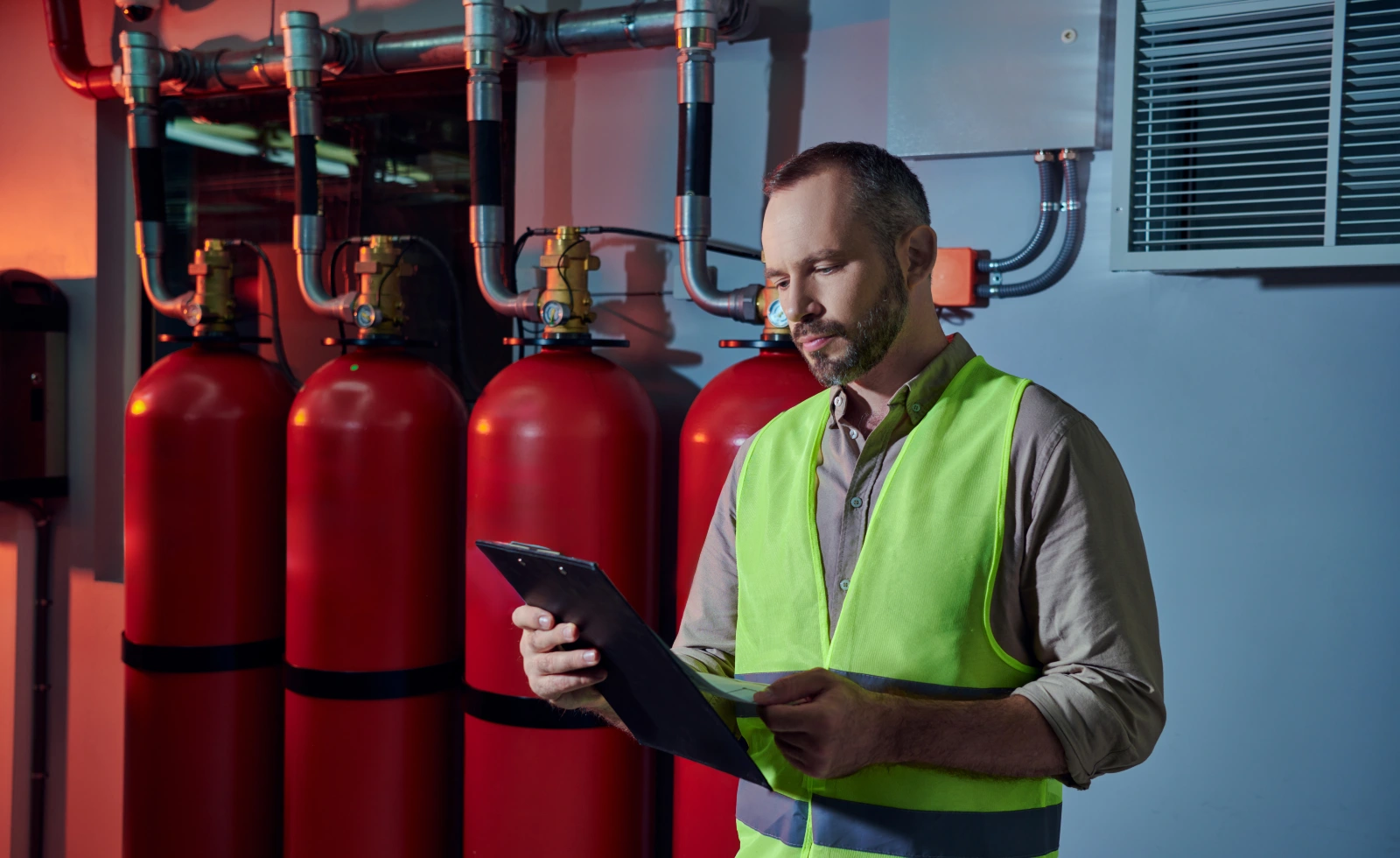
What Is a Fire Risk Assessment?
A fire risk assessment is a systematic evaluation of a workplace or building to identify fire hazards, determine who is at risk, and establish what measures are needed to eliminate or reduce that risk to an acceptable level.
Under fire safety legislation, virtually every non-domestic premises requires a documented fire risk assessment carried out by a competent person. For safety officers, that responsibility often falls directly on you – or on a professional auditor you commission and work alongside.
Why Fire Risk Assessments Matter in today
Workplaces are changing. Hybrid working patterns, new building materials, evolving energy systems including lithium-ion battery storage, and increasingly complex supply chains have introduced fire risks that older assessments simply did not account for. A fire risk assessment completed three years ago may no longer reflect the actual risk profile of your building today.
Beyond legal compliance, a rigorous assessment:
- Reduces the likelihood of fire incidents and associated business disruption
- Protects employees, contractors, visitors, and neighbouring properties
- Demonstrates duty of care to regulators, insurers, and stakeholders
- Forms the foundation of your broader emergency preparedness strategy
Step 1: Prepare Thoroughly Before the Assessment Begins
Strong preparation separates a thorough assessment from a superficial one. Before setting foot on site, gather and review:
- Previous fire risk assessments and any outstanding actions from them
- Fire safety policies and emergency evacuation procedures
- Maintenance and inspection records for fire detection, suppression, and alarm systems
- Staff training logs, including fire warden training records
- Building plans, floor layouts, and details of any recent structural or operational changes
Define the scope clearly at this stage. Are you assessing the entire premises or a specific area? Are there high-risk zones – server rooms, chemical storage areas, commercial kitchens – that require more detailed examination?
Equally important is communication. Inform management, department heads, and relevant employees before the assessment. Their cooperation gives you access to areas, processes, and informal knowledge that paperwork alone will never reveal. Staff who work in a space daily often know about risks that have never been formally logged.
Step 2: Identify All Potential Fire Hazards
This is the investigative core of the entire process. A fire requires three elements – heat, fuel, and oxygen. Your job is to identify where each exists and where they could combine dangerously.
Sources of ignition to examine:
- Electrical equipment and wiring, particularly older or overloaded circuits
- Heating systems and portable heaters
- Hot work processes – welding, cutting, grinding
- Cooking equipment and commercial kitchen operations
- Deliberate ignition risks in areas with public access
Sources of fuel:
- Flammable liquids, gases, and chemicals
- Paper, cardboard, and packaging materials stored near heat sources
- Soft furnishings, textiles, and wall linings
- Waste accumulation, particularly near exits or in storage areas
Sources of oxygen:
- Air conditioning and ventilation systems that could spread fire
- Oxygen cylinders or oxygen-enriched environments in industrial or medical settings
Beyond the fire triangle, assess structural factors: are fire doors functioning correctly and not wedged open? Are escape routes clear, well-lit, and properly signed? Are fire extinguishers of the correct type, properly serviced, and positioned accessibly?
In industrial settings, pay particular attention to machinery overheating, inadequate ventilation around chemical storage, and the proximity of flammable materials to heat-generating equipment.
Step 3: Evaluate Who Is at Risk
Identifying hazards is only half the picture. You must also determine who could be harmed – and how seriously.
Consider:
- Employees working in high-risk areas or lone workers outside normal hours
- Vulnerable individuals – people with mobility impairments, hearing loss, or other conditions affecting their ability to evacuate quickly
- Visitors and contractors unfamiliar with the building layout and evacuation procedures
- Sleeping occupants in premises such as hotels, residential care facilities, or accommodation blocks
- Members of the public in retail, hospitality, or public-facing environments
Each group may require a different approach to evacuation planning, communication, and fire safety training. Personal Emergency Evacuation Plans (PEEPs) should be in place for any individual who cannot self-evacuate.
Step 4: Document Findings and Prioritise Actions
Every finding must be recorded. This is not just a legal requirement – it is the practical foundation of everything that follows.
Your documentation should include:
- A clear description of each identified hazard and its location
- An assessment of the risk level – typically categorised as low, medium, or high
- Photographs and diagrams where they add clarity
- Current control measures already in place and an assessment of their adequacy
- Gaps between current measures and what is actually required
When recording findings, highlight critical risks prominently. Management needs to understand not just what the issues are, but which ones pose the most immediate danger and require urgent action.
From your findings, develop specific, actionable recommendations. Vague guidance like “improve fire safety” is not useful. Effective recommendations are concrete: install a heat detector in the electrical plant room, replace all three fire doors on the second floor, introduce a formal hot works permit system.
Step 5: Implement Fire Safety Improvements
A fire risk assessment that produces recommendations but no action has achieved nothing. Implementation requires structure and accountability.
Develop a formal action plan that includes:
- Each recommended action clearly described
- The person responsible for completing it
- A realistic deadline based on the risk level – high-risk findings need urgent timelines
- The resources required: budget, equipment, contractor involvement, or staff time
Assign ownership clearly. When everyone is responsible, no one is responsible. Named individuals with defined deadlines are far more likely to follow through than vague team-wide obligations.
As improvements are made, document their completion. This creates an audit trail that demonstrates your organisation is actively managing fire risk – not just identifying it.
Step 6: Review and Update the Assessment Regularly
A fire risk assessment is a living document, not a one-time task. It must be reviewed:
- At least annually as standard practice
- Immediately following any fire incident, near miss, or false alarm
- Whenever significant changes occur – new equipment, layout changes, changes in occupancy, new processes or materials
- When relevant fire safety legislation or guidance is updated
The 2026 landscape specifically demands attention to emerging risks: electric vehicle charging points, increased use of lithium-ion batteries in equipment and storage, and the fire behaviour of modern construction materials all represent evolving hazard profiles that require assessments to be kept genuinely current.
Ongoing staff training is equally essential. Fire wardens should receive refresher training regularly, and all employees should understand evacuation procedures for the current building configuration – not a layout that existed three years ago.
Frequently Asked Questions
Who can carry out a fire risk assessment?
It must be carried out by a competent person – someone with sufficient training, knowledge, and experience to identify fire risks and evaluate controls. This may be an in-house safety officer or an external specialist.
How often should a fire risk assessment be reviewed?
At minimum annually, but any significant change to the premises, occupancy, or processes should trigger an immediate review.
What happens if a fire risk assessment is inadequate?
Enforcement authorities can issue improvement notices, prohibition notices, or prosecute responsible persons. In the event of a fire, inadequate documentation can result in serious legal liability.
Does a small business need a fire risk assessment?
Yes. Any non-domestic premises – regardless of size – requires a suitable and sufficient fire risk assessment under fire safety legislation.
Final Thoughts
For safety officers, a well-executed fire risk assessment is one of the most impactful things you can do for the people and buildings in your care. It demands preparation, honest observation, clear documentation, and disciplined follow-through. Keep it current, keep it thorough, and treat every review as an opportunity to catch what you might have missed before.