
Essential Safety Signage That Protects Everyone at the Airport
Walk through any major airport and you are surrounded by an invisible framework of safety ,one that speaks to you through carefully designed signs at every turn. These aren’t decorations or bureaucratic formalities. They are the difference between calm, organized movement and dangerous chaos. From the moment a traveler steps through the terminal doors to the second they board their flight, safety signage quietly directs, warns, informs, and protects.
At Al Salama School of Safety Studies, we understand that effective Health and Safety practice isn’t confined to industrial worksites or training classrooms ,it is woven into the fabric of every high-traffic public environment, and airports are among the most demanding of all. Below, we break down the key categories of airport safety signage and explain why each one matters.
1. Emergency Exit Signs - Your Lifeline in a Crisis
When seconds matter most, emergency exit signs eliminate hesitation. Strategically positioned throughout terminals, jetways, and lounges, these illuminated signs remain visible even through smoke, darkness, or power failure. Their placement is never accidental ,every sign is mapped to ensure unobstructed sightlines from multiple angles. Regular maintenance and operational testing are non-negotiable; a sign that fails during an emergency is worse than none at all.
2. Security Checkpoint Signs - Turning Anxiety Into Order
For millions of international travelers, airport security is a nerve-wracking experience made more stressful by confusion. Clear, multilingual security checkpoint signs cut through that anxiety by guiding passengers step by step through screening procedures. When passengers know exactly where to go and what to expect, queues move faster, stress levels drop, and security staff can focus on their actual job rather than answering the same directional questions repeatedly.
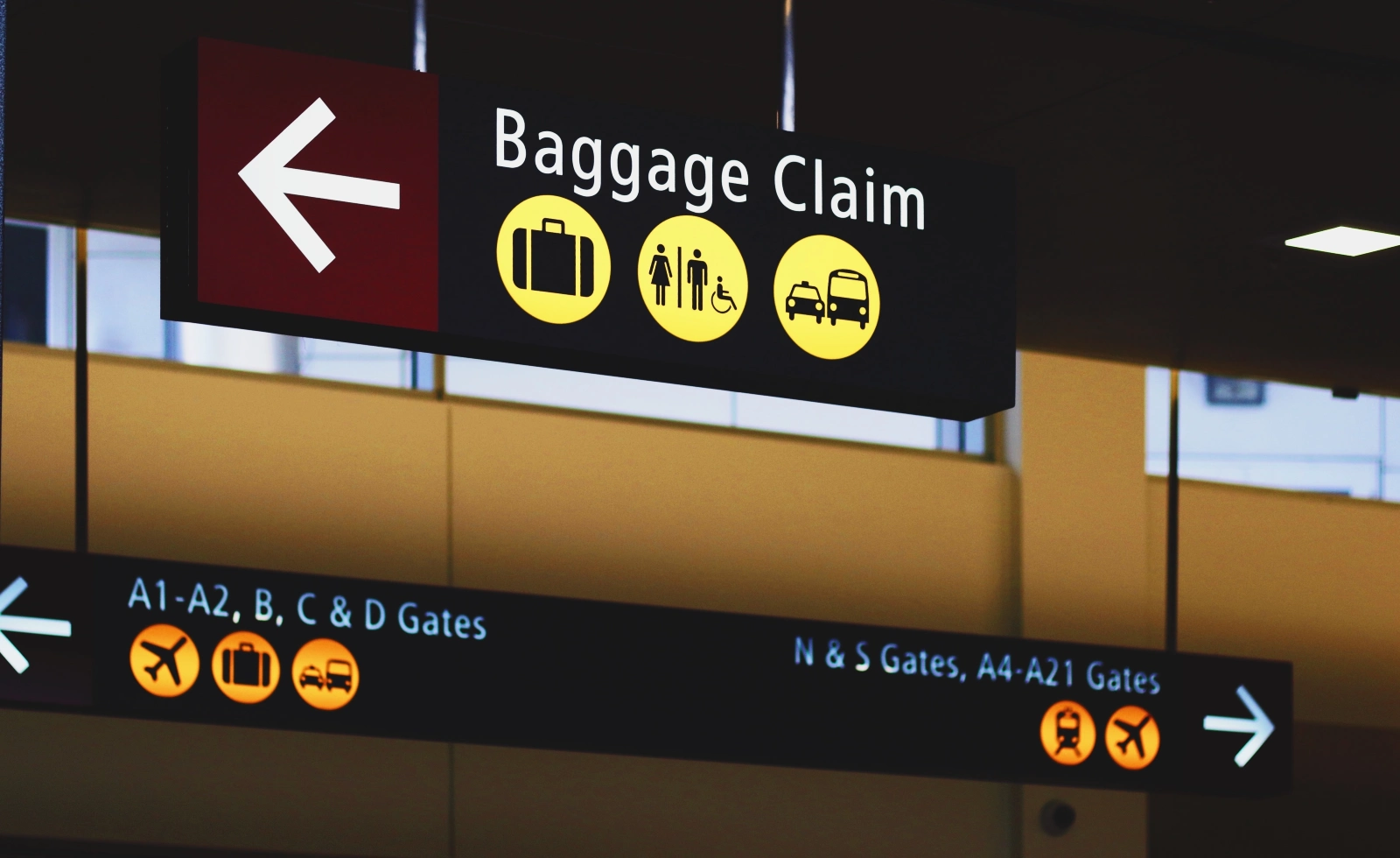
3. Baggage Claim Information - Ending the Luggage Lottery
There are few frustrations quite like watching the same carousel spin endlessly while wondering if your luggage ended up in another city. Baggage claim signage eliminates this uncertainty by directing passengers to the correct carousel with precision. In large airports handling thousands of bags per hour, clear and timely baggage information is essential to prevent overcrowding, reduce stress, and keep the arrivals hall functioning smoothly.
4. Restricted Area Warnings - Where Access Meets Accountability
Not every corridor in an airport is meant for every person. Restricted area warning signs serve as the first line of defense in protecting secure zones from aircraft maintenance areas to baggage handling operations. Using bold text, universal symbols, and high-visibility colors, these signs deter unauthorized entry and reinforce the culture of security that modern aviation demands. Their message is simple: access here is earned, not assumed.
5. Safety Protocol Information - Prepared Before the Emergency Begins
Fire evacuation routes. Emergency equipment locations. Instructions for donning life vests or oxygen masks. Safety protocol signs ensure that neither passengers nor staff are encountering this information for the first time during an actual crisis. Positioned near emergency equipment and in high-traffic areas, these signs compress complex procedures into clear, actionable steps ,delivering calm guidance precisely when it is needed most.
6. Wayfinding Signage - Navigating Complexity With Confidence
A modern international airport can feel like a small city ,and just as confusing to navigate without good directions. Wayfinding signage creates the invisible architecture that moves thousands of people efficiently from check-in to gate, from arrivals to taxi rank. Consistency in design, strategic placement, and clear iconography are the hallmarks of effective wayfinding. When done well, passengers barely notice these signs ,they simply arrive where they need to be.
7. Hazard Warning Signs - Preventing the Preventable
A wet floor after cleaning. A low ceiling in an older terminal. A construction zone near a busy gate. Hazard warning signs exist to draw immediate attention to dangers that passengers and staff might otherwise miss entirely. Bright colors, bold symbols, and unambiguous language are the tools of this category. Beyond preventing injuries, these signs also reflect an airport’s commitment to duty of care ,a legal and ethical obligation to everyone on the premises.
8. Health and Hygiene Reminders - Protecting People, Not Just Property
The COVID-19 pandemic reminded the world that an airport is not just a hub for luggage ,it is a hub for viruses too. Health and hygiene reminder signs have since become a permanent and vital part of the airport environment. Handwashing prompts near restrooms, hand sanitizer station indicators, respiratory etiquette reminders, and mask-wearing guidelines during health emergencies all contribute to a cleaner, safer space for the tens of thousands of people who pass through daily.
9. Information Desks and Help Points - A Human Answer in a Digital World
Technology handles much of the airport experience today, but there are moments when a traveler needs a real person. Signs directing passengers to information desks and help points ensure that assistance is never more than a few steps away. Universal symbols make these signs instantly recognizable regardless of language, and their presence reduces the kind of confused, directionless wandering that creates bottlenecks and frustration in busy terminals.
10. Flight Information Displays - The Airport's Heartbeat
Real-time flight information displays are arguably the most-watched signs in any airport. Departures, arrivals, delays, gate changes, this data shapes the movement of every person in the building. Strategically placed across departure halls, waiting areas, and dining concourses, these displays ensure that no passenger is left standing at the wrong gate wondering why their flight disappeared. Up-to-date, accurate information is not just a convenience ,it is a safety mechanism that prevents rushing, overcrowding, and poor decisions.
11. Customs and Immigration Signage - Clarity at the Border
For international travelers, the customs and immigration process is both procedurally important and often unfamiliar. Multilingual signs with clear symbols reduce the confusion that leads to misdirection, delays, and inadvertent violations of procedure. Good signage in these areas also contributes to national security ,when the flow is orderly and well-directed, officers can focus on their actual duties rather than managing crowds.
12. Ground Transportation Information - The Journey Doesn't End at the Terminal
Arriving passengers need to get somewhere after landing. Signs directing travelers to taxis, buses, metro links, and rental car facilities are essential ,especially for first-time visitors unfamiliar with the city. Clear ground transportation signage reduces the chaotic scramble outside arrivals halls, helps passengers make informed choices quickly, and keeps the exterior of the airport as organized as the interior.
12. Ground Transportation Information - The Journey Doesn't End at the Terminal
In an environment where flammable jet fuel is never far away, no smoking signs carry a weight beyond mere courtesy. Clearly marked smoking restrictions protect infrastructure, reduce fire risk, and ensure that non-smokers ,including children and those with respiratory conditions ,can move through the airport comfortably. These signs are most effective when paired with designated smoking zones, giving compliance a practical outlet.
13. No Smoking Area Signs - Safety and Courtesy Combined
Arriving passengers need to get somewhere after landing. Signs directing travelers to taxis, buses, metro links, and rental car facilities are essential ,especially for first-time visitors unfamiliar with the city. Clear ground transportation signage reduces the chaotic scramble outside arrivals halls, helps passengers make informed choices quickly, and keeps the exterior of the airport as organized as the interior.
14. Luggage Rules and Regulations - Setting Expectations Before Check-In
Oversized carry-ons, prohibited items, and weight limit violations cause significant delays at check-in and security checkpoints. Signage communicating luggage rules before passengers reach these points reduces friction considerably. When travelers understand the rules before they are enforced, the experience is smoother for everyone ,passengers avoid surcharges and confiscations, and staff spend less time managing preventable issues.
15. Social Distancing Markers - A Lesson Learned and Kept
Floor markers and spacing indicators introduced during the pandemic have proven their lasting value. In high-density queuing areas ,check-in desks, security lanes, boarding gates ,these visual cues manage crowd flow even when health emergencies are not a concern. They reduce friction, manage personal space expectations across cultures, and serve as a subtle but effective crowd management tool in one of the world’s most congested environments.
Safety Is Designed, Not Accidental
Every sign described in this article represents a deliberate decision ,a moment where airport planners, safety professionals, and designers asked: what does someone need to know here, and how do we make sure they see it? The cumulative effect of these decisions is an environment where millions of people move safely through one of the most complex and high-stakes settings in modern life.
Safety signage is not a passive afterthought. It is active infrastructure ,and recognizing it as such is the first step toward building, managing, and navigating airports that truly protect everyone within them.