
What Does the NFPA Diamond Stand For and Its Uses: A Beginner Guide
Quick Answer: What Does the NFPA Diamond Stand For?
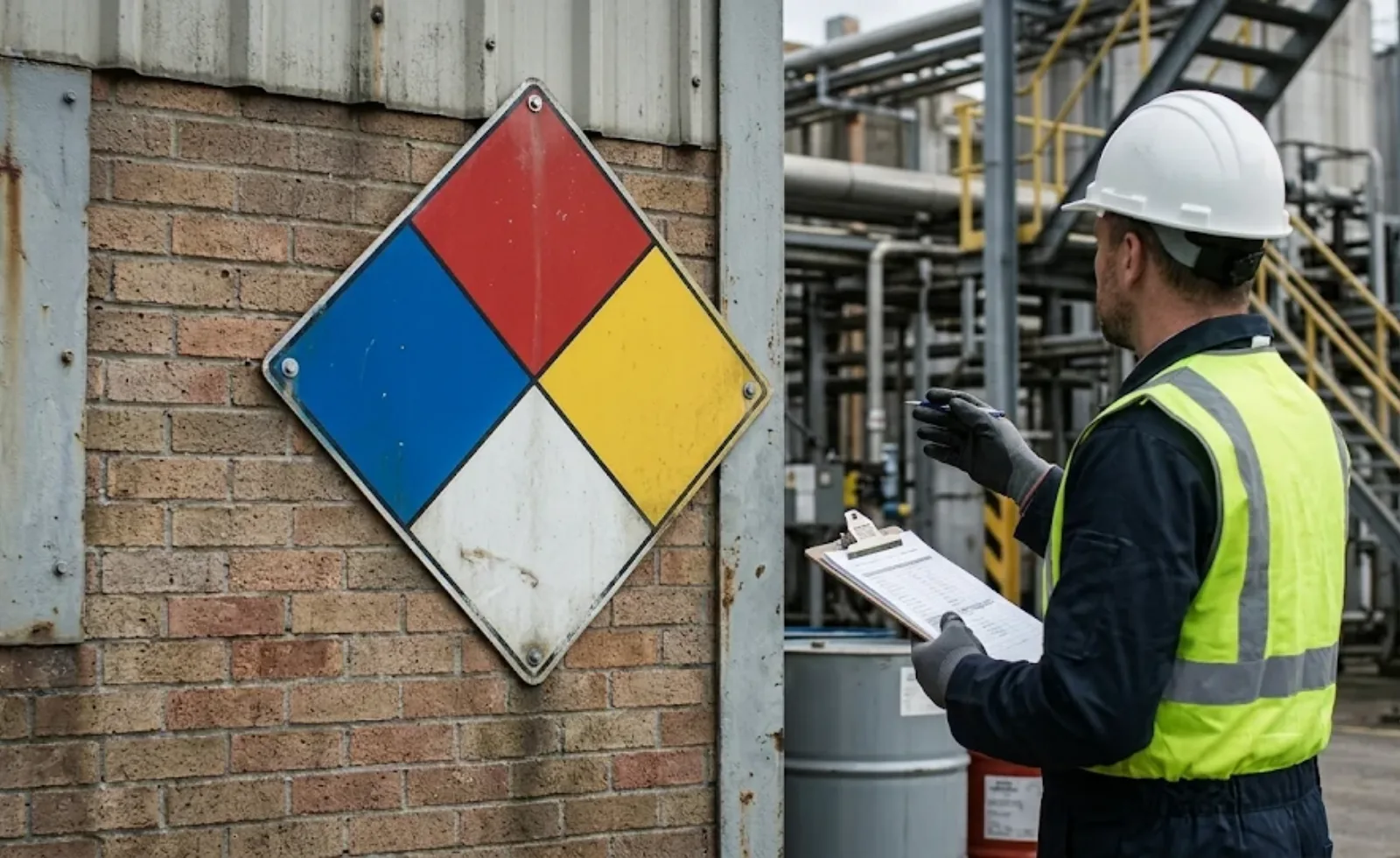
The NFPA diamond stands for the National Fire Protection Association’s NFPA 704 hazard identification system. It is a diamond-shaped label made of four colored squares that tells you, at a glance, how dangerous a material is for health, fire, and chemical instability, and whether it has any special hazards. Its main use is to help workers and emergency responders understand the risks of a chemical before they touch it, store it, or respond to an incident.
If your business stores paint, cleaning chemicals, fuel, gas cylinders, or lab reagents, this small symbol can protect your people, your property, and your reputation.
Why Business Owners Should Care About This Symbol
Most workplace chemical accidents do not happen because people are careless. They happen because people do not know what is inside a container, or they underestimate it. A new employee moves a drum into the wrong room. A contractor opens a storage area during a fire inspection. A firefighter arrives at a night-time incident and has seconds to decide whether to enter.
The NFPA diamond solves all three problems. It gives instant, standardized information without requiring anyone to read a long safety document. For a business owner, that means fewer incidents, smoother inspections, lower insurance risk, and a safer team.
What Is the NFPA Diamond?
The NFPA diamond, also called the NFPA hazard diamond or fire diamond, is a visual warning label created under the NFPA 704 standard. The National Fire Protection Association is a global non-profit organization focused on reducing fire, electrical, and related hazards.
The label was designed mainly for fixed locations: building entrances, chemical storage rooms, tanks, and containers at facilities. It is especially useful for fire fighters and emergency teams who need quick information during an emergency, but it is just as valuable for everyday staff.
Understanding the Four Colors of the NFPA Diamond
The diamond is split into four smaller diamonds, each with its own color and meaning.
Color | Position | What It Shows |
Blue | Left | Health hazard |
Red | Top | Flammability (fire hazard) |
Yellow | Right | Instability (reactivity) |
White | Bottom | Special hazards |
A simple memory trick: think of it as a clock face. Red sits at 12 o’clock for fire, blue sits at 9 for health, yellow sits at 3 for reactivity, and white sits at 6 for special notes.
Reading the Numbers: The 0 to 4 Rating Scale
The blue, red, and yellow sections each carry a number from 0 to 4. A higher number means a higher level of danger. Zero means minimal hazard, and four means severe.
Blue: Health Hazard
This rating shows how harmful a material can be to the human body during a short emergency exposure.
- 0: No unusual health risk beyond ordinary materials
- 1: May cause minor irritation
- 2: Can cause temporary incapacitation or lasting injury with intense exposure
- 3: Can cause serious injury even after short exposure
- 4: Can be life-threatening or fatal after very short exposure
Red: Flammability
This number shows how easily a material catches fire. It is mostly based on the flash point, the lowest temperature at which a liquid gives off enough vapor to ignite.
- 0: Will not burn
- 1: Needs significant heating before it can ignite
- 2: Ignites when moderately heated or in warm conditions
- 3: Can ignite under almost any normal temperature
- 4: Burns extremely easily and may vaporize quickly at normal temperatures
Yellow: Instability
This rating shows how likely a material is to react, decompose, or explode on its own, or when exposed to heat, shock, pressure, or water.
- 0: Stable, even in a fire
- 1: Normally stable but may become unstable when heated
- 2: Can undergo violent chemical change at higher temperatures or pressures
- 3: Can detonate or react explosively if strongly heated, shocked, or confined
- 4: Can detonate or explode readily at normal temperatures
White: Special Hazards
The white square has no number. It holds symbols for unique risks:
- OX: The material is an oxidizer and can make fires burn harder
- W with a line through it: Dangerous reaction with water, so do not use water on it
- SA: Simple asphyxiant gas that can displace oxygen in the air
Some facilities also add other symbols, such as COR for corrosive, but these are not part of the core standard, so always train staff on whatever your site uses.
A Practical Example
Imagine a label showing Blue 2, Red 3, Yellow 0, and a blank white square. That tells a worker the material can cause real harm if inhaled or touched, ignites easily, and is chemically stable on its own. The right response is strict control of ignition sources, good ventilation, and proper protective gear. All of that is understood in about three seconds, without opening a single document.
Main Uses of the NFPA Diamond
1. Protecting Employees
A clear label tells workers how careful they must be. It supports safe handling, correct storage, and the right choice of personal protective equipment.
2. Guiding Emergency Responders
During a fire or spill, responders may have no time to search for paperwork. The diamond helps them decide how to approach, which extinguishing method to avoid, and whether evacuation is needed.
3. Supporting Safe Chemical Storage
Warehouses and labs use the ratings to separate incompatible materials. A highly flammable product should never sit next to a strong oxidizer, and the diamond makes such mistakes easier to spot.
4. Meeting Inspection and Compliance Expectations
Fire authorities, insurers, and safety auditors often expect clear hazard identification at storage areas. Proper signage shows that your business takes safety management seriously.
5. Supporting Training and Awareness
Because the system is visual, it works well in multilingual workplaces. A worker who does not read English fluently can still understand that a high red number means a serious fire risk.
Where Should You Display the NFPA Diamond?
Place the sign where it will be seen before someone enters or interacts with the hazard:
- Doors and entrances to chemical storage rooms
- Outside walls of buildings that hold hazardous materials
- Storage tanks and large fixed containers
- Laboratories, workshops, and maintenance areas
- Loading docks and utility rooms
Make sure the sign is large enough to read from a safe distance, placed at eye level, and kept clean and undamaged.
NFPA Diamond vs. Other Hazard Labels
Business owners often mix up the diamond with other systems. They serve different purposes.
- NFPA 704 diamond: Gives a quick overview of hazards for emergency situations at fixed sites
- GHS labels and Safety Data Sheets (SDS): Give detailed handling, storage, and first aid information for workers using the product
- Transport placards: Used on vehicles and shipments moving chemicals on public roads
The smart approach is to use them together. The diamond gives the headline, and the SDS gives the full story.
Common Mistakes Businesses Make
- Guessing the ratings. Ratings should come from reliable sources, such as the SDS and a competent safety professional.
- Using the diamond on individual small containers. It is intended mainly for rooms, buildings, and larger storage points, while other labels suit small containers.
- Forgetting to update. When you change a chemical or its quantity, the sign may need to change too.
- Skipping training. A label only works if people know how to read it.
- Poor placement. A sign hidden behind shelving or faded by sunlight does not protect anyone.
Practical Tips to Get the Most Out of the Diamond
- Keep an updated inventory of all hazardous materials on site
- Review ratings whenever products or suppliers change
- Include the diamond in new-employee orientation
- Run regular drills so staff and responders know the plan
- Pair the signs with clear emergency contacts and evacuation maps
If you want your team to go beyond recognizing symbols and build real workplace safety skills, a structured Health and Fire Safety Course can help staff understand hazards, prevention, and emergency response in a practical way. Training providers such as Al Salama School of Safety Studies offer programs designed for working professionals who need job-ready knowledge.
Final Thoughts
So, what does the NFPA diamond stand for and its uses in daily business? It stands for a clear, universal way to communicate chemical danger. It protects workers, guides responders, supports compliance, and reduces costly mistakes. Learning to read it takes minutes, yet the benefit can last for years.
Start by walking through your own premises. Look at every storage area and ask one question: if a stranger opened this door tonight, would they understand the risk immediately? If the answer is no, it is time to improve your signage and training.
Frequently Asked Questions
What does the NFPA diamond stand for?
It stands for the NFPA 704 hazard identification system created by the National Fire Protection Association. The diamond shows health, flammability, instability, and special hazards of a material using colors and numbers.
What do the colors on the NFPA diamond mean?
Blue means health hazard, red means flammability, yellow means instability or reactivity, and white means special hazards such as oxidizers or water reactivity.
What does the number 4 mean on an NFPA diamond?
A 4 is the highest rating and signals severe danger. Depending on the color, it can mean a deadly health risk, extreme flammability, or the ability to explode easily.
What does the NFPA diamond number 0 mean?
Zero means the material poses minimal hazard in that category under emergency conditions.
What does the white section of the NFPA diamond show?
The white section carries special symbols. OX marks an oxidizer, W with a line through it warns against using water, and SA identifies a simple asphyxiant gas.
Who uses the NFPA diamond?
Firefighters, emergency responders, factory and warehouse workers, laboratory staff, facility managers, inspectors, and insurers all rely on it.
Is the NFPA diamond the same as a GHS label?
No. The NFPA diamond is a quick overview for emergencies at fixed locations, while GHS labels and Safety Data Sheets give detailed information for people handling the product.
Is the NFPA diamond legally required?
Requirements depend on your country, local fire codes, and the type of facility. Many fire authorities and insurers expect it, so check local regulations or consult a safety professional.
Where should the NFPA diamond be placed?
Place it at entrances to storage rooms, on tanks and buildings that contain hazardous materials, and in any location where responders or workers should see the hazard before entering.
Can I make my own NFPA diamond?
You can create one only if the ratings are determined correctly, usually based on the SDS and expert evaluation. Wrong ratings can mislead responders, so accuracy is essential.
Make Your Workplace Safer Today
A label is only the first step. Real safety comes from trained people who know what to do when something goes wrong. Equip your team with practical hazard recognition, fire prevention, and emergency response skills, and turn your safety signs into a confident, prepared workforce.
Explore professional safety training at alsalamasafety.com and protect your people, your property, and your business before an incident happens.