
Can Static Electricity Cause Fires and Explosions? Industrial Safety Explained
Short answer: yes. Static electricity can cause fires and explosions when a static spark meets a flammable gas, vapor, mist, or dust in the right concentration. The spark can be so small that nobody notices it, yet it can carry enough energy to ignite certain materials.
For business owners, this matters because static-related incidents are often preventable. They rarely come from dramatic equipment failures. More often they come from ordinary tasks like pouring a solvent, filling a drum, or emptying a bag of powder without proper grounding.
This beginner-friendly guide explains how static electricity becomes a fire hazard, where it hides in industrial workplaces, and what you can do to control it.
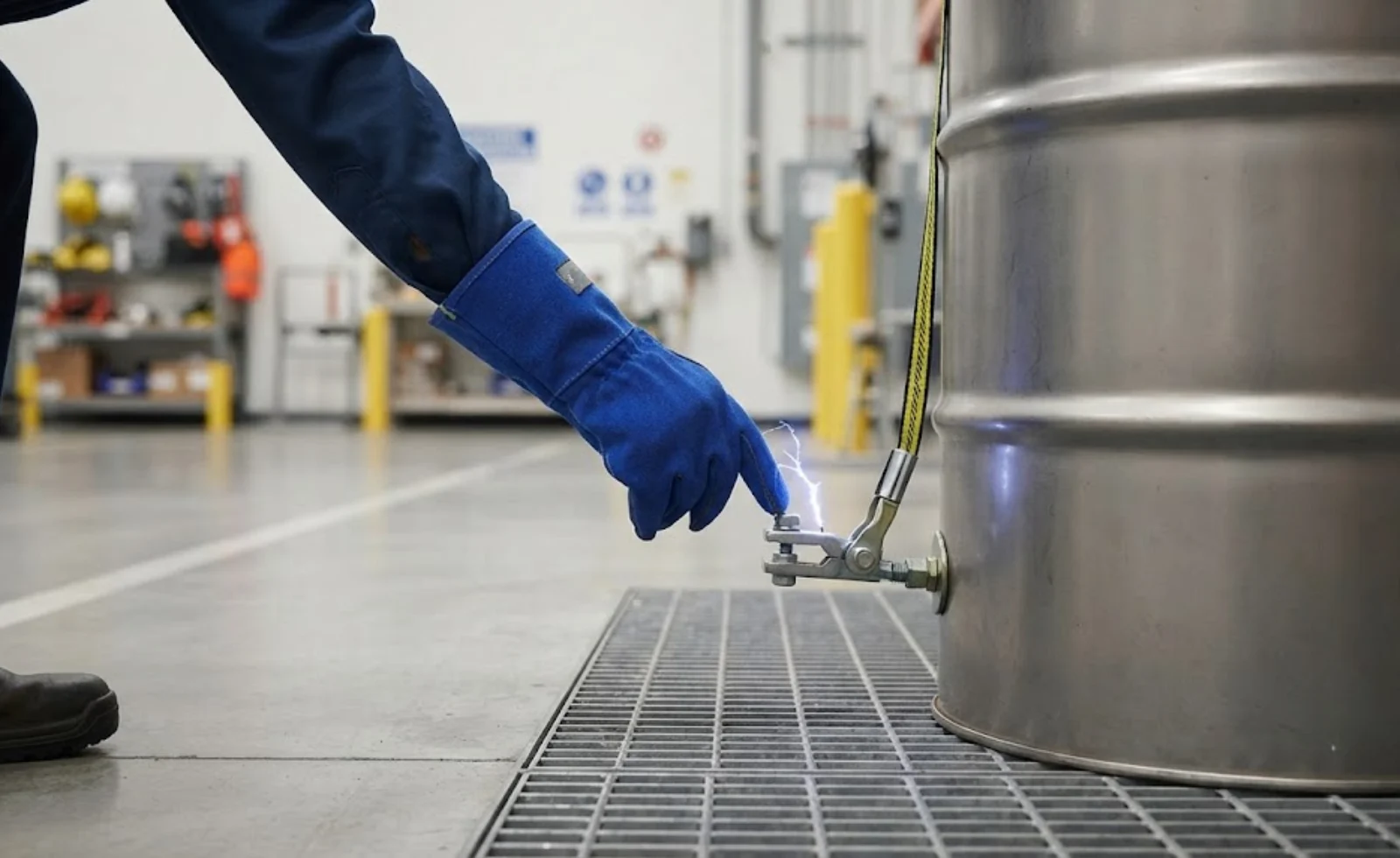
What Is Static Electricity?
Static electricity is an imbalance of electric charge on the surface of a material. When two surfaces touch and then separate, electrons can move from one to the other. One surface ends up with extra negative charge, and the other is left with extra positive charge.
You have felt this when you touched a door handle and got a small shock. That shock was a static discharge, a sudden release of built-up charge.
In daily life it is harmless. In a workplace that handles flammable materials, the same tiny discharge can become an ignition source.
How Does a Static Spark Start a Fire or Explosion?
Every fire or explosion needs three things, often called the fire triangle:
- Fuel: a flammable liquid vapor, gas, or combustible dust
- Oxygen: normally available from the air
- An ignition source: heat, flame, or a spark
In many industrial settings, fuel and oxygen are already present. Static electricity supplies the missing ignition source. Four things must come together:
- Charge generation: materials rub, flow, or separate, creating charge.
- Charge accumulation: the charge cannot escape, usually because the object is insulated or not grounded.
- Spark discharge: the stored charge jumps to a nearby grounded object or person.
- Flammable atmosphere: the spark happens where fuel and oxygen are mixed within the flammable range.
If any one of these is removed, the ignition chain breaks. That is the foundation of static control.
Why Tiny Sparks Are Enough
Every flammable material has a minimum ignition energy (MIE), the smallest amount of spark energy needed to ignite it. Hydrogen and many solvent vapors have very low MIE values, so even a barely visible spark can ignite them. Some fine dusts also ignite with energy levels that a person’s body can easily build up and release.
A person walking across a floor in insulating shoes can build up thousands of volts without feeling anything. That is why static hazards are easy to underestimate.
Common Ways Static Electricity Builds Up at Work
Static charge forms wherever materials move against each other. Common sources include:
- Pouring or pumping flammable liquids: liquid flowing through hoses and pipes generates charge, especially low-conductivity liquids like many fuels and solvents.
- Splash filling: letting liquid drop freely into a tank or container creates more charge, mist, and vapor than filling below the liquid surface.
- Transferring powders and granules: pneumatic conveying, sieving, mixing, and bag emptying all generate charge on particles and equipment.
- Moving conveyor belts and rollers: friction creates charge, particularly on insulating belts.
- Plastic containers, liners, and bags: plastic is a poor conductor, so charge stays put instead of draining away.
- Isolated metal parts: an ungrounded metal funnel, drum, or tool can store charge and release it in one strong spark.
- Personnel: clothing, footwear, and floors can charge a worker, who then discharges to equipment.
- Dry air: low humidity makes charge build up faster and last longer.
Where Static Electricity Is Most Dangerous
Any facility that handles flammable or combustible materials should assess static risk. Higher-risk examples include:
- Chemical and paint manufacturing
- Oil, gas, and petrochemical operations
- Fuel storage and tanker loading
- Pharmaceutical plants handling powders and solvents
- Food, flour, sugar, and grain processing
- Wood, plastics, and metal powder operations
- Printing and coating facilities
- Laboratories that use solvents
Dust explosions deserve special attention. Many owners know that solvents are dangerous but do not realize that a cloud of fine combustible dust, such as flour, sugar, or wood dust, can also explode when ignited.
Real Business Risks Behind Static Incidents
A static ignition is not only a safety problem. It is a business problem. A single incident can lead to:
- Injuries or loss of life
- Damage to equipment, buildings, and stock
- Production shutdowns and delayed orders
- Regulatory investigations, fines, and legal claims
- Higher insurance costs and strained customer relationships
- Damage to your reputation as an employer and supplier
Prevention usually costs far less than recovery. Many static controls are simple, low-cost, and quick to put in place.
How to Prevent Static Fires and Explosions
Effective static control works in layers. No single measure is enough on its own.
- Identify Where Hazards Exist
Start with a hazard review. Map every area where flammable liquids, gases, vapors, or dusts are present, then list the activities that could generate static. Pay special attention to filling, transferring, mixing, and cleaning tasks. Facilities that deal with explosive atmospheres should classify hazardous areas under recognized standards such as ATEX/IECEx or NFPA guidance and select equipment accordingly.
- Use Bonding and Grounding
Bonding connects conductive objects to each other so they stay at the same electrical potential. Grounding connects them to the earth so charge can drain safely.
- Bond a container to the filling equipment before transfer starts.
- Ground all metal tanks, drums, pipes, and funnels.
- Use dedicated bonding clamps and cables, and make sure they contact bare metal, not paint or rust.
- Inspect cables, clamps, and connection points regularly, and test resistance as your standards require.
- Control How You Transfer Liquids and Powders
- Use bottom filling or dip pipes rather than splash filling.
- Keep initial flow rates low until the inlet is submerged.
- Allow a relaxation period after filling before sampling or dipping, so charge can dissipate.
- Use closed transfer systems wherever possible to reduce vapor release.
- Choose the Right Materials and Equipment
- Prefer conductive or static-dissipative containers, hoses, and liners in hazardous zones.
- Avoid ordinary plastic buckets, funnels, and bags near flammable vapors or fine dust.
- Use intrinsically safe or properly rated equipment in classified areas.
- Select antistatic belts and rollers for Conveyor systems.
- Protect People
- Provide antistatic footwear and suitable clothing in hazardous areas.
- Install conductive or dissipative flooring where needed.
- Ban the use of synthetic outer garments that can generate charge in high-risk zones, and set clear rules for removing layers.
- Give workers a way to ground themselves before handling flammable materials.
- Manage the Environment
- Where practical, control humidity, since moister air helps charge dissipate.
- Reduce dust and vapor accumulation with good housekeeping and ventilation.
- Clean up dust regularly, because layered dust can be disturbed into an explosive cloud.
- Train People and Write It Down
Equipment alone will not protect your site if workers do not understand why static matters. Build clear procedures, post warning signs, run toolbox talks, and reinforce the message through audits and supervision. Many incidents happen when a worker skips a “small” step, like skipping the bonding clamp, because nothing bad has happened before.
Quick Static Safety Checklist for Business Owners
- Have we identified every area with flammable vapors, gases, or dusts?
- Are all metal containers, tanks, and equipment bonded and grounded?
- Do we avoid splash filling and uncontrolled pouring?
- Are our containers, hoses, and tools suitable for hazardous areas?
- Do workers wear approved antistatic footwear and clothing where required?
- Are bonding and grounding connections inspected and tested on a schedule?
- Is dust cleaned up routinely?
- Have all employees received static hazard training?
If you answered “no” or “not sure” to any item, that is a good place to start.
Building a Safety-First Team
Technology and procedures only work when competent people run them. Supervisors, safety officers, and plant managers need a solid understanding of fire behavior, hazard assessment, and emergency response. Structured learning, such as a Diploma in Health and Fire Safety Course, can give your team the technical grounding to spot ignition risks like static before they turn into incidents.
Frequently Asked Questions
Can static electricity really cause an explosion?
Yes. If a static spark occurs in an atmosphere containing flammable gas, vapor, or dust within its explosive range, it can ignite the mixture and cause a fire or explosion. The spark does not need to be large or visible.
How much static electricity is needed to ignite a fire?
It depends on the material. Each flammable substance has a minimum ignition energy. Some gases and vapors can be ignited by extremely small discharges, which is why even small sparks matter in hazardous areas.
What is the difference between bonding and grounding?
Bonding links two or more conductive objects so they remain at the same electrical potential and cannot spark between each other. Grounding connects an object to the earth so excess charge can drain away. Safe operations usually need both.
Can humans generate enough static to cause ignition?
Yes. A person can accumulate a charge through movement, clothing, and insulating footwear, and then discharge it to equipment. In some atmospheres, that spark is enough to ignite vapor or dust.
Are plastic containers dangerous around flammable liquids?
They can be. Plastic does not conduct electricity well, so charge cannot easily drain away. Ungrounded plastic containers or funnels may build up charge and discharge into a flammable atmosphere. Use approved, conductive, or static-dissipative options in hazardous zones.
Does humidity affect static electricity?
Yes. Dry air allows static charge to build up and persist, while higher humidity helps charge leak away. However, humidity control alone is not a reliable safeguard, so it should support, not replace, bonding and grounding.
Can dust explode from static electricity?
Yes. Fine combustible dusts such as flour, sugar, wood, and some metal and chemical powders can form explosive clouds in air. A static discharge can be the ignition source that sets them off.
How often should grounding and bonding systems be checked?
Inspect them visually before use and test them on a regular schedule defined by your risk assessment, manufacturer guidance, and applicable standards. Damaged clamps, loose cables, and corroded contacts should be fixed immediately.
What industries face the highest static electricity risks?
Oil and gas, chemicals, paints and coatings, pharmaceuticals, food processing, plastics, woodworking, printing, and fuel handling all face elevated risks because they work with flammable liquids, gases, or fine dusts.
Protect Your People and Your Business Before a Spark Does Damage
Static electricity is easy to ignore because it is invisible and usually harmless. In the wrong environment, though, one unnoticed spark can cost lives, assets, and years of hard work.
The good news is that static hazards can be controlled with awareness, the right equipment, and well-trained people.