
Internal vs External HACCP Audits: What’s the Difference?
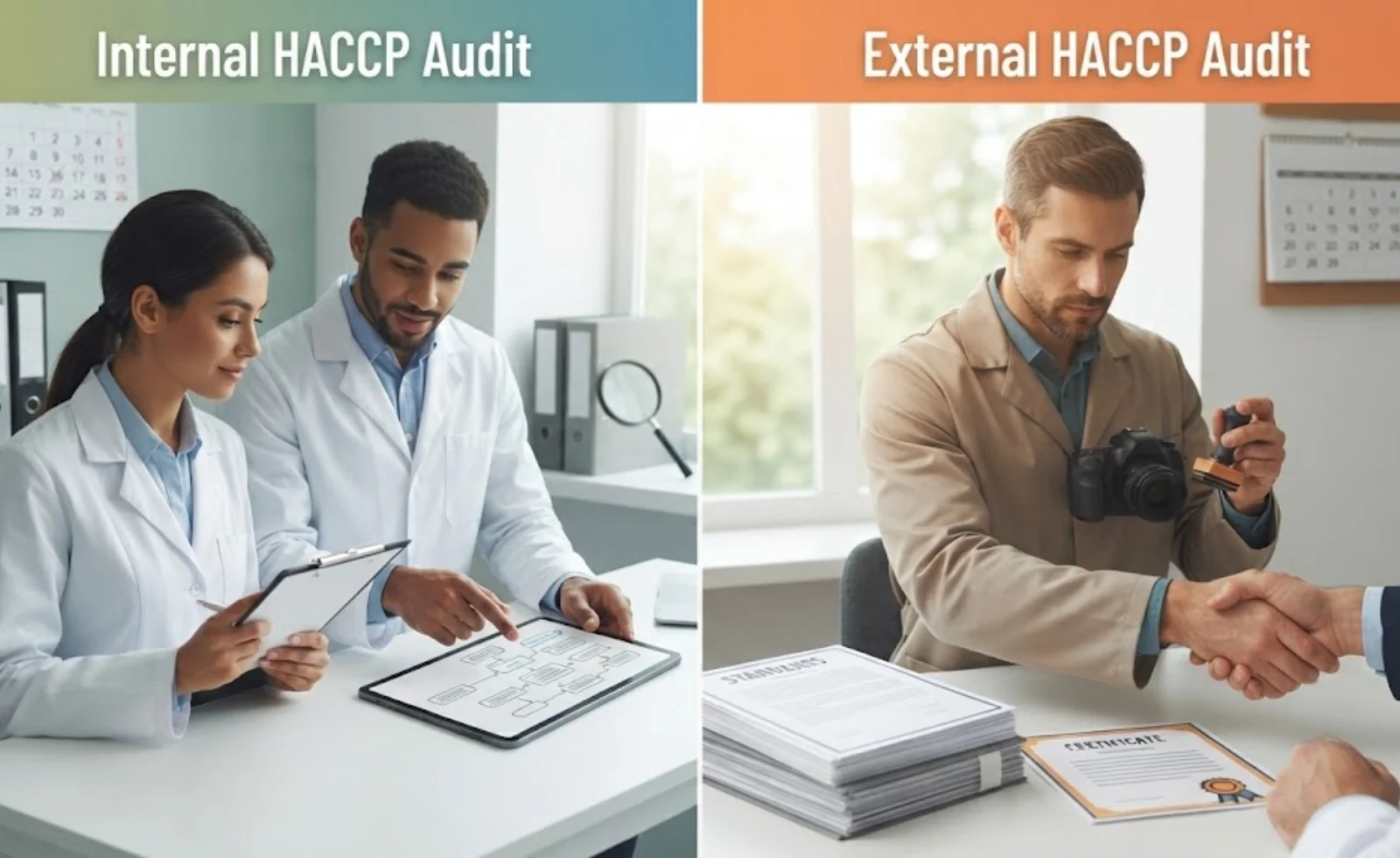
Quick answer: An internal HACCP audit is a self-check carried out by your own trained team to find and fix food safety gaps before anyone else sees them. An external HACCP audit is an independent assessment by an outside party, such as a certification body, regulator, or customer, who verifies that your system meets a defined standard. Internal audits help you improve. External audits prove you comply. A strong food business needs both.
Why This Question Matters for Your Business
Imagine a buyer asks to see your HACCP certificate next week. Or an inspector arrives unannounced. Or a customer complaint triggers an investigation. In each case, the quality of your audit habits decides whether you stay calm or scramble.
Many food business owners, especially in small and mid-sized operations, treat audits as paperwork they must survive. That mindset is expensive. Failed audits can mean lost contracts, product recalls, fines, and damage to your brand that takes years to repair.
Understanding the difference between internal and external HACCP audits helps you plan better, spend less on corrective actions, and walk into every inspection prepared.
What Is a HACCP Audit?
HACCP stands for Hazard Analysis and Critical Control Points. It is a preventive system that identifies biological, chemical, and physical hazards in your food process and controls them at the points where they matter most.
A HACCP audit is a structured review that answers two simple questions:
- Is your HACCP plan well designed? Does it identify the right hazards and set sensible controls?
- Is your team actually following it? Do daily records, temperatures, cleaning checks, and corrective actions match what the plan says?
Auditors compare your documents, your processes, and your people against the plan and the relevant standard. The difference between internal and external audits comes down to who does the checking and why.
What Is an Internal HACCP Audit?
An internal audit is conducted by people from within your organisation. These could be your food safety team members, quality assurance staff, or a trained supervisor who does not audit their own department.
Main purpose: To find problems early, fix them quickly, and keep your system healthy between outside visits.
What it usually covers:
- Whether the HACCP plan still matches your current menu, recipes, and equipment
- Monitoring records at critical control points (cooking temperatures, chilling times, metal detection checks)
- Calibration of thermometers and other instruments
- Supplier approval and incoming goods checks
- Cleaning and sanitation effectiveness
- Staff hygiene practices and training records
- Closure of earlier corrective actions
Key features:
- You control the schedule, so it can be monthly, quarterly, or after a process change
- It is lower in cost, with no certification fees
- Findings stay inside the business
- It builds food safety awareness among staff
- It carries no formal certification result
What Is an External HACCP Audit?
An external audit is performed by someone outside your organisation. There are three common types:
- Third-party (certification) audit: A certification body assesses you against a recognised standard, such as ISO 22000 or an approved GFSI-benchmarked scheme, and issues a certificate if you pass.
- Second-party audit: A customer, retailer, or distributor audits you to confirm you meet their supplier requirements.
- Regulatory inspection: A government food authority checks that you meet legal requirements. The aim is legal compliance rather than certification.
Main purpose: To give independent proof that your food safety system works and meets an agreed standard.
Key features:
- The auditor is impartial and has no stake in your internal politics
- Dates are often fixed in advance, though regulators and some customers may arrive unannounced
- It carries a cost, including audit fees and the time your team spends
- Results are formal, with grades, non-conformities, and deadlines
- A passed audit can open doors to new markets, tenders, and export buyers
Internal vs External HACCP Audits: Side-by-Side Comparison
Factor | Internal Audit | External Audit |
Who conducts it | Your trained in-house team | Independent certification body, customer, or regulator |
Main goal | Improvement and early problem detection | Verification, certification, or legal compliance |
Frequency | Set by you (often quarterly or more) | Usually annual, with surveillance visits |
Cost | Low (staff time) | Higher (fees plus preparation) |
Objectivity | Can be affected by familiarity | High, as the auditor is independent |
Outcome | Internal report and action plan | Certificate, grade, or formal non-conformity report |
Stakes | Low pressure, safe to find faults | High pressure, as results affect business |
Scheduling | Flexible | Fixed or surprise, depending on the party |
The Real Difference: Practice vs. Proof
The simplest way to remember it is this: an internal audit is practice, and an external audit is the match.
Athletes train daily so that match day feels familiar. In the same way, regular internal audits are where you discover that a thermometer was out of calibration, a cleaning record was missing, or a new supplier was never approved. You fix these quietly, at no penalty.
If you skip that practice, the external auditor finds the same issues, but now they appear on an official report and can cost you a certificate or a customer.
When Do You Need Each One?
You should run an internal audit when:
- You are building or updating a HACCP system
- You launch a new product, recipe, or production line
- You change suppliers, equipment, or premises
- A complaint, near-miss, or recall occurs
- You are preparing for a certification or customer audit
- Staff turnover has been high
You will face an external audit when:
- You seek certification to enter retail or export markets
- A major buyer requires proof of supplier compliance
- Your food authority schedules a routine or risk-based inspection
- Your certificate comes up for annual surveillance or renewal
Common Mistakes Businesses Make
- Treating internal audits as a tick-box exercise. If the same person audits their own work every time, blind spots grow. Rotate auditors so no one reviews their own area.
- Auditing only paperwork. Records can look perfect while the floor tells a different story. Walk the production line, watch staff, and ask questions.
- Not closing corrective actions. Finding a problem is half the job. Auditors, especially external ones, will check whether last year’s issues were actually fixed.
- Cramming before the external audit. Last-minute record writing is easy to spot. Consistent daily records are far more convincing.
- Skipping auditor training. An untrained internal auditor may miss critical gaps or misunderstand requirements. Competence matters.
How Internal Audits Make External Audits Easier
Businesses that audit well internally usually see smoother external results. Here is why:
- Fewer surprises. You have already found and fixed most weaknesses.
- Better records. Teams that expect regular checks keep records current.
- Confident staff. Employees who have been questioned before handle auditor questions calmly.
- Lower cost over time. Fixing a small gap early is cheaper than managing a major non-conformity, a re-audit, or a lost contract.
A Simple Step-by-Step Plan to Get Started
You do not need a large quality department. Here is a practical approach for a small or growing business:
- Build an annual audit schedule. Divide your HACCP system into areas (receiving, storage, production, packaging, dispatch, sanitation) and audit each at planned intervals.
- Use a checklist based on your own HACCP plan. Generic checklists miss site-specific risks.
- Select independent auditors. Use staff who are not responsible for the area being checked.
- Record evidence, not opinions. Note what you saw, which record you reviewed, and what was said.
- Grade findings by risk. Separate critical issues from minor observations.
- Assign owners and deadlines. Every finding needs a responsible person and a date.
- Verify the fix. Re-check that corrective actions worked.
- Review results in management meetings. Leadership involvement shows commitment and gets resources approved.
Why Training Is the Missing Piece
Both audit types rely on people who understand HACCP principles. An internal auditor must know what a critical control point is, how to judge whether monitoring is adequate, and how to write findings that lead to real improvement. Without that knowledge, even well-intentioned audits fall short.
This is why many food businesses invest in formal learning. If you are looking for structured, practical HACCP Certification Courses in Kerala, Al Salama School of Safety Studies offers training designed to help food professionals understand HACCP systems and apply them in real working environments.
Which One Is More Important?
Neither replaces the other. They serve different purposes:
- Internal audits keep your system alive and improving day to day.
- External audits give customers, regulators, and markets the confidence to trust you.
Think of them as two halves of one assurance cycle. Internal audits find and fix issues. External audits confirm that the system holds up under independent scrutiny.
Frequently Asked Questions
What is the main difference between an internal and an external HACCP audit?
An internal audit is done by your own trained staff to improve your system. An external audit is done by an independent party, such as a certification body, customer, or regulator, to verify compliance with a standard or law.
Is an internal HACCP audit mandatory?
Most recognised food safety standards, including ISO 22000-based schemes, require internal audits as part of verification. Even where not strictly required by law, they are considered best practice.
How often should internal HACCP audits be done?
There is no single rule. Many businesses audit every quarter or at least twice a year, and they add extra audits after major changes or incidents. Higher-risk operations should audit more often.
Can the same person do both the internal audit and fix the issues?
They can fix issues in their own area, but they should not audit their own work. Independence within the business improves objectivity
Who can perform an external HACCP audit?
Accredited certification bodies, customer representatives (second-party auditors), and government food safety inspectors can all carry out external audits, each with a different purpose.
Can an internal audit replace an external audit?
No. Internal audits improve your system but cannot provide independent certification or satisfy a customer or regulator who requires outside verification.
What happens if I fail an external HACCP audit?
You usually receive a report listing non-conformities with deadlines for corrective action. Serious failures can delay or withdraw certification, so a follow-up audit may be needed.
How should I prepare for an external HACCP audit?
Run a full internal audit first, close all open corrective actions, confirm records are current and accurate, and make sure staff understand their roles in the HACCP system.
Do small food businesses need HACCP audits?
Yes. The scale may be simpler, but the principle is the same. Small businesses face the same food safety risks and often serve customers who expect proof of safe practices.
How can I become a competent HACCP internal auditor?
Take a structured training course covering HACCP principles, audit techniques, and reporting. Practical learning with real-world examples helps most.
Ready to Build Audit-Ready Confidence?
Do not wait for an inspector, a buyer, or a complaint to reveal where your food safety system is weak. Strong HACCP knowledge in your team turns audits from a source of stress into a routine checkpoint.
Train your people. Strengthen your system. Win trust before it is tested.
Contact Al Salama School of Safety Studies today to learn how our training can prepare you and your team for internal checks and external certification success.